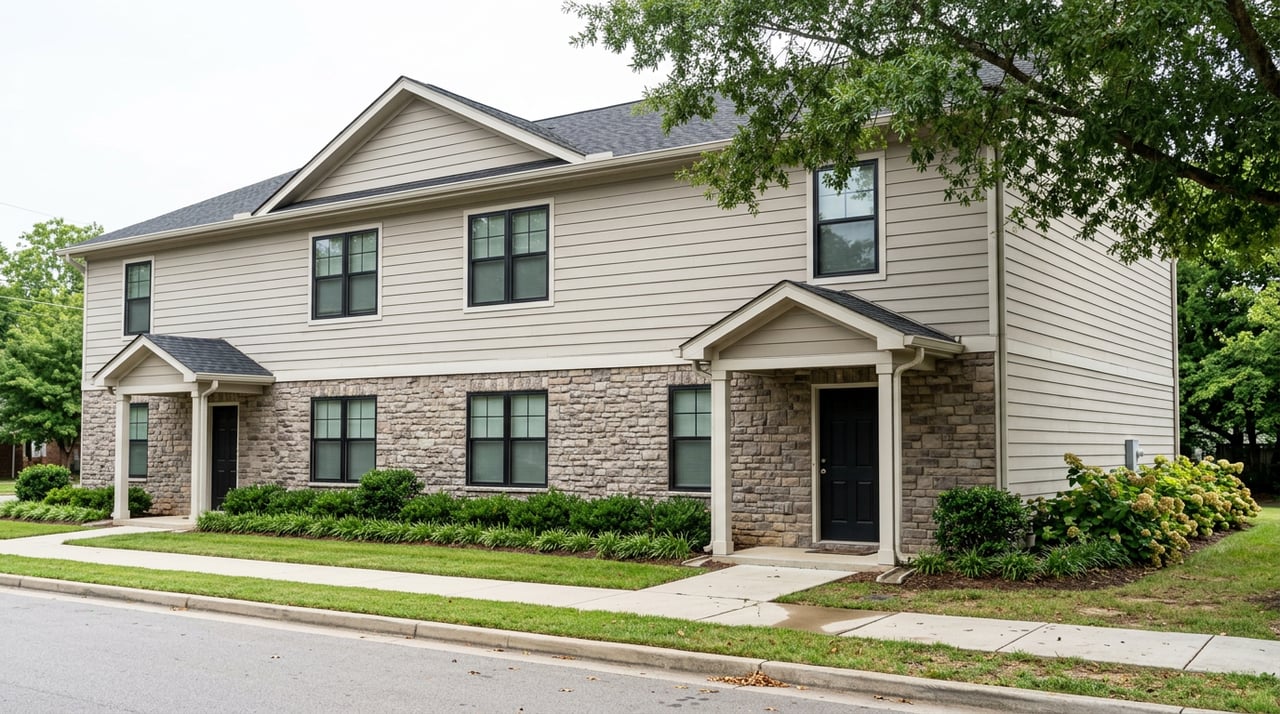
Durham Rental Investment Cap Rates by Neighborhood
August 20, 2026
August 20, 2026
Which Durham submarket has the best cap rate right now is the wrong question. It sounds like the right question. It produces a clean number you can compare across a spreadsheet. But in 2026, three very different parts of Durham are producing cap rates in the same narrow band for three completely different reasons, and an investor who buys on the number alone is buying a story they haven't read past the headline.
Raleigh-Durham multifamily cap rates averaged between 5.0% and 5.5% through 2025, with Durham specifically landing at 5.5% in the fourth quarter, according to Northmarq's investment sales research. That range sounds like a market speaking with one voice. It isn't. Downtown Durham, the Duke West Campus corridor, and the Research Triangle Park/South Durham stretch all land near that number for reasons that would make a Durham-specific underwriter nervous if they were treated as interchangeable.
Downtown Durham posted the highest concentration of multifamily sales in the city in 2025, with activity surging late in the year, per Northmarq's Q4 report. That sounds like conviction. Investors are showing up. But look at what actually changed hands: 80% of the properties that traded downtown were built before 2000. That runs directly counter to the market-wide pattern, where properties built in the 2020s made up roughly 30% of Raleigh-Durham sales and 2000s and 2010s vintages combined for another 30%.
In practice, that means the 5.5% cap rate downtown buyers are accepting isn't a bargain on a modern asset. It's the market pricing in the roof, the HVAC systems, and the plumbing that a 1980s or 1990s building is going to need before the decade is out. A buyer comparing a downtown 5.5% against a newer-build 5.5% elsewhere is comparing two different products that happen to share a number. One includes a capital improvement budget baked in whether the buyer plans for it or not.
Durham's Proactive Rental Inspection Program applies to all residential rentals in the city, which means deferred maintenance on an older downtown building doesn't stay invisible for long. Reserve planning here isn't optional. It's the price of entry.
Head fifteen minutes northeast and the story flips. Zumper's May 2026 data showed average rent in RTP at $2,295, up 34.24% year over year. That's the kind of figure that gets circled in a deal memo. It also deserves more scrutiny than most investors give it.
That growth is tracking new construction leasing up in a corridor that's been mostly parking lots and office buildings until recently. The Research Triangle Foundation's HUB RTP effort brought the Horseshoe online, a 160,000-square-foot retail and office project that drew restaurants from chefs like Preeti Waas and a second location for Prime Barbecue into the heart of the park, part of a multi-phase build-out that has also included apartment buildings and a planned Marriott hotel targeted for a 2026 opening.
Layer on Wolfspeed's materials plant in neighboring Chatham County, which had 344 active employees testing systems as of early 2025 with a path toward as many as 1,800 jobs if it hits its hiring targets tied to nearly $800 million in state incentives. That's real, near-term labor demand pulling on housing in the same corridor.
A 34% jump against a small, recent base of new units isn't the same signal as 34% appreciation across an established rental stock. It's what happens when a handful of new buildings lease up fast in a place that had almost no comparable inventory a few years ago. That can be a genuinely good sign for an investor buying into the next phase of that same growth. It's a different sign than "rents here just went up a third for everyone."
Between those two extremes sits the Duke University West Campus corridor, where Zumper's May 2026 numbers showed a more measured 11% year-over-year rent growth, a median rent of $1,613, and 92% renter-occupied households. That's not a headline number. It's also arguably the most legible one on this list: an established, tenant-dense market near a large, stable employer, growing at a pace that doesn't require an explanation involving a semiconductor plant three counties over.
Here's how the three compare on the numbers that matter for underwriting a deal today:
| Submarket | Recent rent signal | What's driving it | Investor read |
|---|---|---|---|
| Downtown Durham | $1,624 (Northmarq, Q4 2025) to $1,852 (Zumper, May 2026) | Highest 2025 sales volume, 80% of trades pre-2000 vintage | Cap rate reflects capex risk on older stock, not a discount |
| RTP / South Durham | $2,295, up 34.24% YoY (Zumper, May 2026) | New supply lease-up tied to HUB RTP and nearby Wolfspeed hiring | Growth is a new-market effect, not broad-based appreciation |
| Duke West Campus | $1,613, up 11% YoY, 92% renter-occupied (Zumper, May 2026) | Established, employer-anchored tenant base | Steadiest comparison of the three, least explaining required |
None of this matters if the financing math doesn't clear, and right now it often doesn't for a leveraged buyer chasing the average. As of late July 2026, the live 30-year conventional mortgage rate sat at 6.797%, with investment property loans typically pricing half a point to a full point above that, putting most investor financing in the 7.3% to 7.8% range. Durham commercial mortgage rates were quoted starting around 6.34% in mid-August 2026 for qualifying net-lease property, with most deals in 2026 sized to a 1.25x debt-service-coverage ratio rather than to maximum loan-to-value.
Borrow at 7.5% against a property producing a 5.5% cap rate and the math is upside down before a single tenant signs a lease. That's negative leverage: the cost of the debt exceeds the return the asset produces, and every dollar borrowed makes the deal worse rather than better. It's why the buyers actually closing on Durham multifamily right now tend to be paying cash, buying with a value-add plan that raises the effective yield, or structuring the deal in a way that doesn't require matching a headline cap rate to a headline mortgage rate.
That's the piece the citywide average leaves out. The best deal in Durham this year usually isn't the highest number on a report. It's the one where the buyer's financing structure and the property's actual condition were matched to each other before the offer went in.
Is a 5.5% cap rate a bad deal in Durham right now? Not automatically, but it depends entirely on what you're buying at that rate. On a newer downtown building it can be a fair, stabilized return. On one of the pre-2000 properties that made up 80% of last year's downtown trades, that same number is doing double duty as a capital reserve line you'll need to fund yourself.
Does RTP's 34% rent growth mean I should buy there today? It means the corridor is absorbing new supply quickly, which is a genuinely useful signal if you're evaluating a new-construction or pre-leasing opportunity tied to that same growth wave. It's a weaker signal if you're pricing an older asset in the area as if that growth applies broadly.
What does negative leverage actually mean for a buy-and-hold purchase? It means your borrowing cost is higher than the return the property produces on its own, so financing the purchase makes your day-one position worse, not better. At 2026 rates, that pushes many Durham multifamily buyers toward all-cash purchases, value-add repositioning, or creative financing structures instead of a straightforward leveraged buy at the market cap rate.
If you're weighing a Durham buy-and-hold purchase against the numbers in this piece, The Cedeno Group sources off-market inventory across these corridors and structures financing, including owner-finance options, around the deal actually in front of you rather than the citywide average. Reach out and let's run your numbers.
Find Your Dream Home — Habla con Nosotros
Stay up to date on the latest real estate trends.
At The Cedeno Group, our agents are all fully bilingual in English and Spanish, ensuring seamless communication for our diverse clientele. With extensive experience in the real estate market, we go beyond traditional approaches, offering out-of-the-box opportunities to help clients achieve their real estate goals. Whether buying, selling, or investing, our team is dedicated to making the process smooth, successful, and tailored to each client's unique needs.
Get In Touch With Our Team To Learn More

The Cedeno Group Real Estate
5826 Fayetteville Rd, Suite 206 Durham, NC 27713